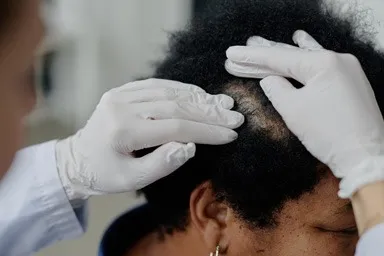
Hair loss in women can appear as a widening part, a thinner hairline or reduced volume across the scalp. A hair transplant for women may improve coverage in carefully selected cases, but it is not the right treatment for every pattern of thinning. The most important first step is finding out why the hair is being lost.
A female hair transplant moves existing follicles from a donor area—usually the back or sides of the scalp—to an area needing greater coverage. It does not create new hair or stop future thinning elsewhere. For that reason, a reliable diagnosis, adequate donor hair and realistic expectations matter more than choosing a procedure based on its name.
This guide explains who may benefit, how FUE, FUT and DHI differ, what recovery looks like month by month, and when medical or non-surgical treatment may be the better choice. If you are exploring treatment in Istanbul, you can also review our female hair transplant service in Turkey.
Key Takeaways
- Diagnosis comes first. Genetic thinning, temporary shedding and inflammatory conditions require different treatment plans.
- Not every woman is a candidate. Surgery is more likely to help when hair loss is stable and the donor area contains sufficiently healthy hair.
- Method choice is individual. FUE and FUT describe harvesting techniques; DHI describes a way of implanting grafts.
- Results take time. New growth usually develops over months, with fuller results often assessed around 10–18 months.
- Non-surgical care matters. Medication, treatment of an underlying condition and cosmetic alternatives may be preferable to surgery.
What Is a Hair Transplant for Women?
During hair transplantation, a clinician harvests small groups of follicles, called grafts, from an area with suitable donor hair and places them into the recipient area. The goal is to improve the appearance of density or reshape a specific hairline while preserving enough hair at the donor site.
The process is similar for men and women, but the pattern of hair loss in women often makes treatment planning more complex. Male pattern hair loss frequently leaves a relatively well-defined donor region. Female pattern hair loss may produce thinning across a broader area, and in some women the donor region is also affected. A donor area that looks full at first glance is not necessarily stable.
Transplantation may improve a visible area, such as a temple or hairline, but it cannot restore the original density of an entire scalp. The likely improvement depends on the available grafts, hair characteristics, scalp health and any ongoing hair loss.
What Causes Hair Loss in Women?
Hair loss is a symptom with several possible causes. A woman with permanent, localized thinning may need a very different plan from someone experiencing sudden shedding after illness or childbirth. Our separate guide to female pattern hair loss and its causes covers these conditions in more detail.
Female pattern hair loss
Also called female androgenetic alopecia, this condition commonly causes progressive thinning over the central scalp or a widening part. It may begin before or after menopause. Some women retain a stable donor area and may be considered for surgery; others are better served by medical treatment because thinning is widespread.
Hormonal changes, illness and nutritional factors
Conditions such as thyroid disorders, iron deficiency and polycystic ovary syndrome (PCOS) can be associated with hair changes. After pregnancy, significant illness, rapid weight loss or major stress, temporary shedding called telogen effluvium may occur. Surgery is generally not the first step when shedding may improve after the trigger is addressed.
Traction, autoimmune and scarring hair loss
Tight hairstyles can cause traction alopecia, which may become permanent after prolonged tension. Alopecia areata causes unpredictable patches of hair loss, while some inflammatory scalp diseases can permanently damage follicles. Active inflammation, irritation or unexplained patches need specialist assessment before transplantation is discussed. Selected stable scars or permanent localized traction-related hair loss may be considered for surgery.
Who Is a Suitable Candidate for a Female Hair Transplant?
Suitability is determined by the diagnosis and donor area, not by age or the size of the thinning area alone. The following table offers general guidance; it is not a way to diagnose yourself or confirm eligibility for surgery.
| Factor | More favourable for transplantation | Reason for extra caution |
|---|---|---|
| Pattern of hair loss | Stable, defined thinning at the hairline, temples or another limited area | Diffuse thinning that is actively worsening or affects the whole scalp |
| Donor hair | Adequate density and limited miniaturization in the donor region | Weak, thinning or insufficient donor hair |
| Underlying cause | A confirmed diagnosis with any relevant condition appropriately managed | Unexplained shedding, untreated medical issues or active inflammatory disease |
| Expectations | A realistic goal of better coverage or a refined hairline | An expectation of completely restoring original hair density |
| Long-term plan | Willingness to monitor future thinning and protect existing hair | A plan that ignores likely progression or uses too much donor hair |
In some patients, hair restoration may be appropriate for a naturally high hairline, an old surgical scar or stable traction alopecia. Scarred tissue can behave differently from healthy scalp, so results and graft survival are less predictable. By contrast, women with diffuse unpatterned alopecia and no dependable donor area are generally poor candidates.
What happens during the consultation?
A thorough assessment includes your medical history, when and how thinning began, previous treatments and a close examination of the entire scalp. A specialist may use trichoscopy to assess hair thickness and follicle miniaturization in the donor and recipient areas. Blood tests or a scalp biopsy are recommended only when clinical findings suggest they are needed to establish the cause.
The consultation should also establish what is achievable with the available donor hair, whether treatment should be tried before surgery, and how any future hair loss could affect the result.
FUE, FUT and DHI: Which Hair Transplant Technique Is Best for Women?
There is no universally best technique for every woman. FUE and FUT describe different ways to collect donor grafts. DHI refers to implantation using a specialized implanter, and it can be paired with grafts harvested by FUE. The medical assessment should determine the method—not the other way around.
| Technique | How it works | Main considerations |
|---|---|---|
| FUE (Follicular Unit Extraction) | Individual follicular units are harvested with small punches. | Produces many small donor scars rather than one linear scar. The donor area is often shaved or partially shaved, although unshaven approaches may be possible. |
| FUT (Follicular Unit Transplantation) | A narrow strip of donor scalp is removed, and follicular units are prepared from it. | Usually avoids extensive donor shaving but leaves a linear scar and involves stitches. It may be considered when preserving surrounding donor density is important. |
| DHI (Direct Hair Implantation) | Prepared grafts are inserted with an implanter pen that creates the recipient opening as the graft is placed. | An implantation approach rather than a separate harvesting technique. Shaving needs and outcomes still depend on the case and the harvesting method. |
Read more about the methods in our detailed guides to FUE hair transplantation, FUT hair transplantation and DHI hair transplantation.
Do women have to shave their heads for a hair transplant?
Not always. Traditional FUE often involves shaving at least part of the donor area, whereas selected cases may be suitable for partial-shave or unshaven FUE. FUT typically requires trimming only the narrow donor strip. DHI does not automatically mean that no shaving is needed: the harvesting plan is what largely determines this. Discuss hairstyle, hair length, graft numbers and any non-shave options in advance.
How Does a Female Hair Transplant Procedure Work?
- Assessment and planning: The team confirms suitability, discusses expected coverage, designs the recipient area and reviews the donor supply.
- Local anaesthesia: The scalp is numbed. Sedation may be used where appropriate according to the clinic's medical protocol.
- Donor harvesting: Follicles are collected by FUE or FUT while preserving the remaining donor hair.
- Graft preparation and placement: Follicular units are handled carefully and implanted to follow a natural direction and distribution.
- Aftercare and follow-up: You receive instructions for washing, sleeping, medication, activity and follow-up assessments.
Most procedures are completed as day surgery, but duration, number of sessions and the exact technique vary. A responsible plan should explain who performs each surgical step and how your care will continue after you return home.
Female Hair Transplant Recovery: Month-by-Month Timeline
Recovery has two different parts: the scalp heals in the first days and weeks, while new hair growth develops over many months. Hair often sheds before visible regrowth begins. The stages below are typical estimates, not a guaranteed schedule for every patient.
| Time after surgery | What you may notice | What matters most |
|---|---|---|
| Days 1–7 | Tenderness, mild swelling, redness and small crusts around grafts. | Protect the area, sleep as advised and follow your clinic's washing schedule. |
| Weeks 1–2 | Scabs gradually loosen; the donor area continues to heal. | Avoid scratching or rubbing. Some patients prefer time away from work while visible signs settle. |
| Weeks 2–8 | Transplanted hair shafts commonly shed; temporary shedding of nearby existing hair may also occur. | Understand that shedding does not automatically mean the grafts have failed. |
| Months 2–4 | Visible change may be limited before fine new hairs begin emerging. | Keep follow-up appointments and continue any clinician-recommended treatment. |
| Months 4–9 | More hairs become visible, with gradual improvement in coverage and texture. | Assess progress over months rather than days; growth can be uneven. |
| Months 10–18 | Hair usually continues to thicken and mature; some areas take longer. | Review the result with your clinician and plan long-term care for native hair. |
For a more extensive explanation of the growth cycle, see our hair transplant growth and recovery timeline.
What is shock loss after a hair transplant?
Patients often use the term shock loss for shedding after surgery. Transplanted hair shafts commonly shed in the weeks following implantation while the follicles remain in the scalp. Some nearby native hairs may also shed temporarily as a response to surgery. Not every area regrows at the same pace, and unusual or persistent loss should be assessed by the treating clinician.
When can you return to work and normal activities?
Many people plan around one to two weeks for the most visible early healing, although the right amount of time off depends on the procedure, job, swelling and personal comfort. Avoid strenuous exercise and pressure on the grafts until your treating team says it is safe. Washing instructions differ by technique, so your surgeon's specific plan takes precedence over generic online timelines.
What Results Can Women Realistically Expect?
A good result may make the part line look less prominent, improve coverage around the temples or create a more balanced hairline. The effect depends on the density and calibre of donor hair, the size of the recipient area, graft placement and whether native hair continues to thin.
There is no universal success rate for every female patient. Figures that promise near-perfect graft survival or guaranteed density do not account for differences in diagnosis and donor quality. A meaningful outcome is not just whether transplanted follicles grow, but whether they produce an improvement that looks natural as the surrounding hair changes over time.
When reviewing photographs, compare cases with similar patterns of hair loss and ask how long after surgery the images were taken. Our female hair transplant before-and-after gallery provides examples; individual results will vary.
Risks and Limitations of Female Hair Transplant Surgery
Hair transplantation is surgery, even when performed under local anaesthesia. An informed decision includes the following possible complications and limitations:
- Bleeding, infection, swelling, temporary numbness or a reaction to medication or anaesthesia.
- Small dot-like donor scars after FUE or a linear scar after FUT; scars may be more visible with certain hairstyles.
- Temporary shedding of transplanted or surrounding native hair.
- Uneven growth, less density than hoped for, an unnatural hairline or grafts that do not grow as expected.
- Overharvesting that reduces the appearance of density in the donor area.
- Continuing hair loss in non-transplanted areas, potentially altering the appearance of the result later.
If you develop increasing pain, spreading redness, fever, discharge, significant bleeding or another unexpected symptom, contact your treating team promptly and seek urgent local medical care when needed. Learn more about planning and provider-related problems in our article on how hair transplants can go wrong.
Alternatives to a Hair Transplant for Women
A transplant is not the only way to address female hair loss. Treatment should match the diagnosis and may aim to slow thinning, encourage regrowth, treat a medical condition or improve cosmetic coverage without surgery.
Topical minoxidil and other prescription treatments
Topical minoxidil is an established treatment for female pattern hair loss and can help some women maintain or increase hair density. It usually requires ongoing use, and results take months. Dermatologists may also consider certain prescription medications, such as spironolactone or low-dose oral minoxidil, for selected patients; these options have important precautions and may be prescribed off-label. Do not begin treatment without appropriate professional advice, especially if you are pregnant, breastfeeding or planning pregnancy.
PRP and low-level laser therapy
Platelet-rich plasma (PRP) involves injecting a preparation derived from the patient's blood into the scalp. Low-level laser devices use light-based treatment over repeated sessions. Both are used for some types of hair loss, but evidence varies by device, protocol and diagnosis. Neither should be presented as a guaranteed substitute for medical evaluation or transplantation.
Addressing the cause and non-surgical coverage
When hair loss is related to a medical condition, treating that condition may be the most effective first step. Wigs, hair fibres, toppers and changes in styling can also provide immediate cosmetic coverage without risking donor hair. Nutritional supplements should generally be considered when an actual deficiency is identified, rather than used routinely for every type of hair loss.
Hairline lowering surgery
For some women concerned primarily about a naturally high forehead rather than thinning, hairline lowering surgery may be a separate option. It involves advancing the hair-bearing scalp and has different suitability requirements, scars and risks from transplantation.
How Much Does a Female Hair Transplant Cost in Turkey?
The price depends on the treatment plan, graft numbers, harvesting and implantation methods, the clinical team and what is included in aftercare or travel arrangements. Care in Turkey's general hair transplant information gives an indicative Turkey-wide range of €1,500–€4,000; this is not a fixed price or a personalized quotation for female patients.
A responsible quote should make clear what is included, who is performing the procedure, whether additional investigations are needed, how follow-up works after travel and what happens if a complication arises. It is better to establish that transplantation is appropriate before comparing packages by price. Explore our hair transplant treatment overview for general information about treatment in Istanbul.
Questions to Ask Before Booking a Female Hair Transplant
- What is my diagnosis, and could medical treatment be more appropriate than surgery?
- Have you checked the donor region for thinning or follicle miniaturization?
- Why are you recommending FUE, FUT or a particular implantation method for my case?
- How many grafts are planned, and how will donor density be protected?
- Who will perform the harvesting and implantation, and what qualifications do they hold?
- What realistic improvement should I expect, and how will future hair loss be managed?
- What follow-up support is available after I return home, and what is the plan if something goes wrong?
Frequently Asked Questions
Are hair transplants successful for women?
They can produce worthwhile improvements in carefully selected women with a confirmed diagnosis, stable donor hair and realistic expectations. Results vary, so one success-rate percentage cannot reliably describe every patient.
Can women with PCOS get a hair transplant?
Possibly, but a clinician should first assess whether PCOS or another condition is contributing to ongoing thinning. If the hair loss is stable, localized and the donor area is suitable, surgery may be considered. A transplant does not treat the hormonal condition itself.
Is DHI better than FUE for women?
They are not directly equivalent. FUE describes how grafts are harvested, while DHI describes how they are implanted. The best plan depends on hair loss pattern, graft availability, shaving preferences and the clinical team's assessment.
Will I need to shave my head?
Not necessarily. Some patients can have partial-shave or unshaven FUE, and FUT typically requires only a narrow donor section to be trimmed. DHI does not automatically eliminate shaving. Your surgeon should explain what is feasible for your case.
Does a female hair transplant hurt?
Local anaesthesia is used to numb the scalp, although the injections may cause short-lived discomfort. Mild tenderness, swelling or soreness can occur afterwards, and the intensity varies by method and patient.
When will I see results after surgery?
New growth often becomes apparent around the third or fourth month, with more noticeable changes later in the first year. Fuller results may take approximately 10–18 months, sometimes longer depending on the area and individual healing.
Can I colour my hair after a hair transplant?
Hair dye and other chemical treatments should be avoided while the scalp heals. Ask your surgeon when your skin and graft sites have recovered enough for colouring; a commonly suggested waiting period is several weeks, but the right timing is individual.
Can a hair transplant stop future hair loss?
No. Transplantation relocates existing follicles but does not stop ongoing loss in non-transplanted hair. Some patients need long-term medical management or additional treatment to maintain a balanced appearance.
Is PRP better than a hair transplant?
They address different needs. PRP is a non-surgical treatment with variable evidence for hair density; transplantation redistributes follicles into an area needing coverage. The appropriate option depends on diagnosis, donor supply, goals and the potential benefits of medical therapy.
Can I have surgery for hair loss after pregnancy?
Postpartum shedding is often temporary. It is usually better to allow time for recovery and obtain a diagnosis before considering surgery. A dermatologist can assess persistent thinning and advise on safe treatment, especially during breastfeeding.
Considering Female Hair Restoration in Turkey?
The first question is not how many grafts can be transplanted, but whether surgery is likely to provide a meaningful, lasting benefit in your case. Care in Turkey can help you explore the available treatment pathways in Istanbul and understand the importance of a detailed medical assessment before any procedure is planned.
See our hair transplant options for women to learn more and request an individual consultation. A clinician should confirm your diagnosis, candidacy and treatment plan before surgery is arranged.
Medical References
- International Society of Hair Restoration Surgery: A Guide to Hair Transplant for Women
- American Academy of Dermatology: Female Pattern Hair Loss
- NHS: Hair Transplant—Procedure, Recovery and Risks
Medical information is provided for general education and is not a diagnosis or a substitute for advice from a qualified healthcare professional. Treatment recommendations must be individualized.